Thermal Fogging in Dallas, TX
When a fire burns, superheated smoke expands under high pressure, driving microscopic combustion oils deep into the pores of wood framing, subflooring, drywall cavities, and attic insulation. Once the structure cools, these microscopic pores contract, locking volatile smoke compounds inside. Standard cold-mist sprayers or atmospheric air fresheners produce large droplets (20 to 50 microns) that merely coat the outer surface, failing to penetrate where the smoke is actually trapped.
Our Dallas-based restoration teams utilize industrial thermal fogging across all 51 Dallas ZIP codes. Thermal foggers heat specialized solvent-based deodorizing counteracting agents, vaporizing them into an ultra-fine aerosol mist with particle sizes between 0.5 and 2 microns—the exact physical size of real smoke. This heated fog follows the identical thermal pathways taken by the original fire, penetrating deep into structural framing pores and wall cavities to chemically pair with and permanently neutralize trapped smoke molecules.
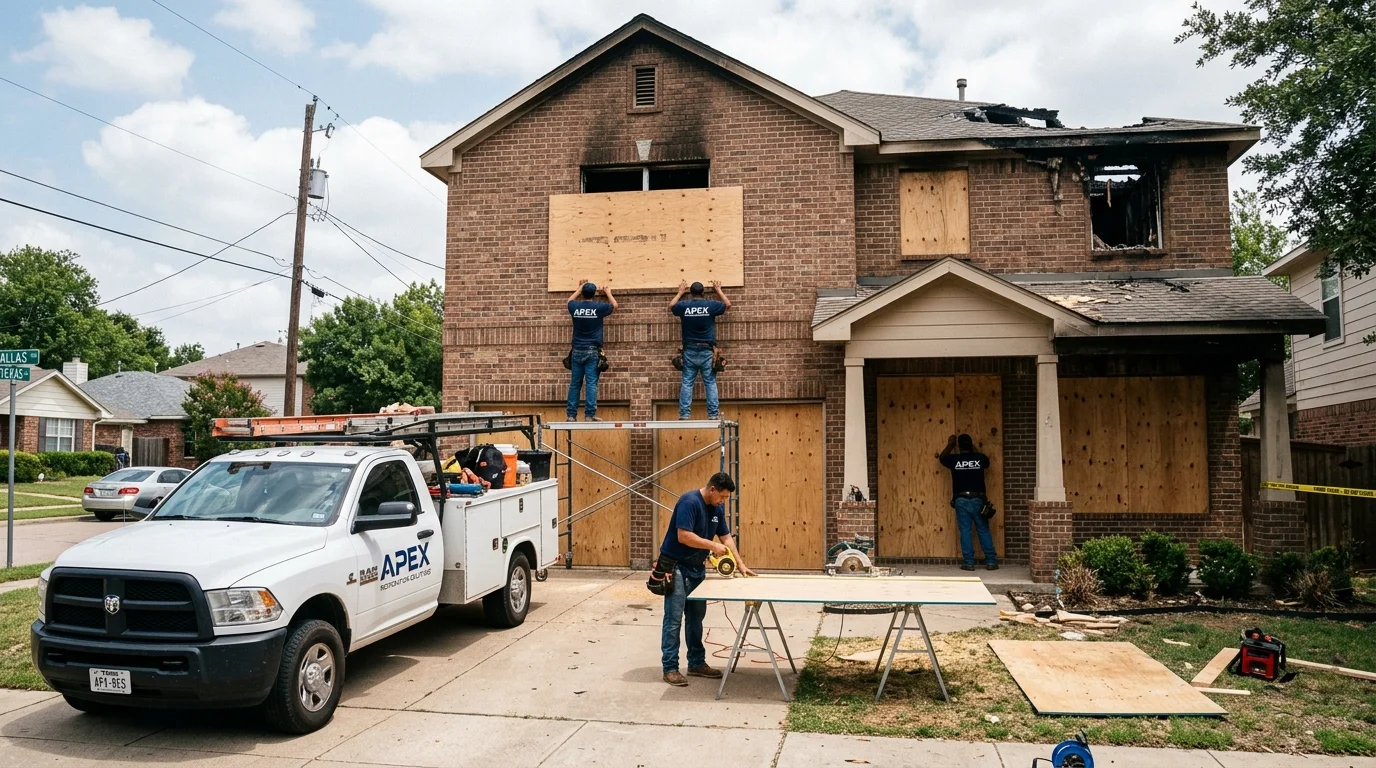
Dallas Smoke & Odor Neutralization Desk
IICRC Master Fire & Smoke specialists deployed with thermal fogging & hydroxyl systems.
How Does Professional Thermal Fogging Work?
Thermal fogging is a precision thermo-chemical process requiring specialized equipment, environmental preparation, and expert application:
Site Preparation & Alarm Disarming
Thermal fog produces a dense, opaque white fog that mimics smoke. Technicians notify the Dallas Fire Department and temporarily disarm local smoke detectors to prevent false alarms.
Property Containment & Evacuation
Windows and exterior doors are sealed with plastic sheeting. Because the fog contains specialized petroleum-distillate pairing agents, occupants and pets are evacuated during fogging.
Thermal Vaporization Chamber
Specially formulated chemical pairing agents are fed into an industrial thermal fogging unit, where an electric chamber heats the solution to 400°F to 500°F, instantly vaporizing it into a dry micro-aerosol.
Pressurized Cavity Injection
Technicians systematically direct the fog through living spaces, into attic voids, across crawlspaces, and directly into open wall cavities.
Chemical Pairing Reaction
As dry fog penetrates porous materials, its active counteracting molecules collide with and chemically pair with volatile smoke molecules, forming stable, non-volatile compounds.
Controlled Ventilation & Clearance
After allowing the fog to dwell and absorb for 4 to 8 hours, technicians ventilate the property using commercial negative-air fans, clearing all residual mist.
The Physics of Thermal Fogging: Why Droplet Size Matters
The scientific advantage of thermal fogging lies in its ability to replicate the physical behavior of combustion smoke:
Replicating Smoke Behavior (0.5 to 2.0 Microns)
Thermal fog droplets are engineered to match the exact physical dimensions of combustion smoke.
Enters the tightest wood pores, subflooring seams, and insulation batts where cold mists cannot penetrate.
Chemical Pairing Reaction
Unlike ozone which strips electrons, thermal pairing agents chemically bond to smoke molecules.
Permanently transforms volatile organic compounds into non-volatile, odorless structures.
Frequently Asked Questions
Will thermal fogging leave an oily residue on my furniture or walls?
No. When operated by certified technicians who maintain the correct machine temperature and application distance, thermal fog produces a dry micro-mist that suspends in the air and absorbs into porous materials without leaving oily films or greasy residues on finished surfaces.
Why do you have to turn off pilot lights before thermal fogging?
Thermal fogging solutions use highly refined solvent and petroleum-distillate carriers. In dense concentrations near open flames, these heated micro-droplets could ignite. As a strict safety standard, our crews extinguish all gas pilot lights and disconnect spark igniters before fogging begins.
Can my family stay in the home while thermal fogging is being performed?
No. The dense fog reduces visibility and the chemical pairing agents can irritate lungs and eyes. The home must be vacated during the fogging procedure and dwell time (typically 4 to 8 hours), after which our crews thoroughly air out the property.
How does thermal fogging differ from ozone treatment?
Thermal fogging uses heated chemical pairing agents that mimic smoke to penetrate pores and bind with odor molecules. Ozone treatment is an electrical gas oxidation process that breaks molecular bonds. In severe fire losses, our technicians frequently combine both methods for maximum deodorization efficacy.
Related Smoke, Soot & Odor Solutions
Overview of comprehensive molecular odor elimination.
High-output O3 gas chamber oxidation for unoccupied structures.
Safe-for-occupied-spaces UV atmospheric radical decontamination.
HEPA negative-air filtration and activated carbon gas purifiers.
Available Across All 51 Dallas ZIP Codes
Our emergency response and restoration specialists deploy 24/7 across every Dallas County neighborhood. Select your local district below for localized response details:
Fire Recovery & Technical Insights
What to Do in the First 24 Hours After a House Fire
Critical safety, insurance notification, and board-up steps once fire officials release the scene.
Understanding Smoke and Soot Types: Wet, Dry & Protein
Why household cleaning smears acidic soot and how chemical counteractants stop etching.
Navigating Fire Damage Insurance Claims
How Xactimate line-item estimates, ACV vs RCV, and Texas building ordinance coverage work.