HVAC & Indoor Air Quality Fire Damage Restoration in Dallas, TX
During a residential or commercial structure fire, the heating, ventilation, and air conditioning (HVAC) system functions as an involuntary distribution highway for toxic combustion byproducts. As pressure differentials develop and return air grilles pull air toward air handlers, millions of microscopic soot particles, acidic chemical aerosols, polycyclic aromatic hydrocarbons (PAHs), and carbon monoxide are forced through the mechanical network.
Attempting to re-energize an HVAC unit without systematic mechanical decontamination re-contaminates restored living areas within seconds. Our Dallas HVAC and indoor air quality restoration division delivers comprehensive mechanical decontamination, air duct cleaning, industrial HEPA air scrubbing, and scientific indoor air quality clearance testing across all 51 Dallas ZIP codes.
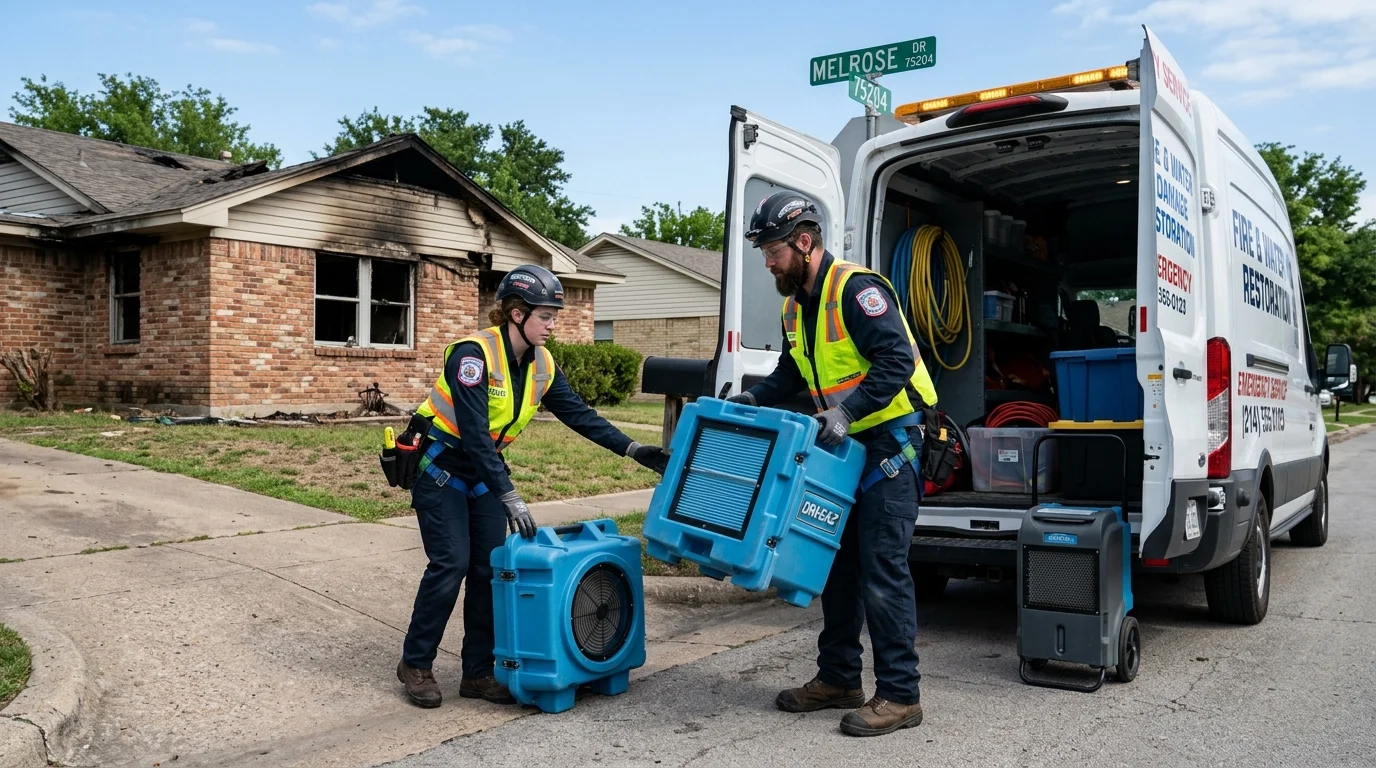
Dallas HVAC & Air Quality Restoration Desk
NADCA certified ventilation mechanics & environmental air quality specialists deployed across Dallas County.
Scope Exclusivity: Mechanical Systems & Certified Air Purity
Block 8 serves as the exclusive technical authority for forced-air mechanical distribution systems, mechanical equipment decontamination, and quantitative air quality certification:
Mechanical Air Distribution Systems
Supply plenums, return air chases, rigid sheet metal ductwork, flexible branch runs, fiberglass duct boards, registers, grilles, and volume dampers.
Central Air Handling Units (AHU)
Evaporator cooling coils, condensing units, heat exchangers, variable-speed blower assemblies, condensate drain pans, and control cabinets.
Negative-Air Source Removal
Truck-mounted and commercial portable vacuum collectors generating up to 5,000+ CFM of negative air pressure to extract dislodged particulate matter without indoor release.
Industrial True HEPA Air Scrubbing
High-volume multi-stage air filtration utilizing certified 99.97% DOP-tested True HEPA media to achieve 6 to 12 room air exchanges per hour.
Scientific Air Quality Verification
Real-time laser particle counter assessments (PM2.5, PM10), photoionization detection (PID) for volatile organic compounds, and combustion gas monitoring.
Explore Our Specialized HVAC & Air Quality Divisions
Navigate our complete spectrum of mechanical restoration and air quality services tailored for Dallas residential properties, commercial offices, and multi-family facilities:
HVAC Smoke Damage Cleaning
Chemical washdown of air handler cabinets, plenums, dampers, and blower wheels to strip sticky, corrosive smoke varnish.
HVAC Soot Removal
Precision vacuuming and non-acidic chemical foam extraction from delicate evaporator coil fins and heat exchanger tubes.
Air Duct Fire Damage Cleaning
NADCA ACR-compliant negative-air source removal, pneumatic air whips, and forward/reverse skips.
HVAC Decontamination
EPA-registered antimicrobial sanitation to eliminate moisture-induced microbial growth on damp interior metal housings.
Air Quality Testing After Fire
Laser particle counting (PM2.5/PM10), TVOC air sampling, and written clearance certification for municipal re-occupancy.
Post-Fire HEPA Filtration
Industrial continuous negative-air scrubbers and multi-stage carbon gas-phase chemisorption modules.
Ventilation Cleaning After Fire
Ultrasonic and chemical immersion cleaning of supply grilles, diffusers, and bathroom exhaust vents.
Carbon Monoxide Testing After Fire
Electrochemical flue gas analysis, heat exchanger integrity testing, and combustion safety checks.
North Texas Climate & HVAC Architecture Challenges
Restoring mechanical systems following a fire in Dallas requires an understanding of regional architectural configurations:
Attic-Mounted Split Systems
Throughout North Texas subdivisions—from Plano and Frisco to Lake Highlands and Preston Hollow—furnaces and air handlers are frequently positioned in unconditioned attic spaces where elevated temperatures accelerate soot bonding to exterior duct insulation.
Return Air Chases & Open Plenums
Many mid-century Dallas residences utilize framed wall cavities as return air chases rather than enclosed metal ductwork, requiring specialized contact HEPA vacuuming and polymer sealant encapsulation.
High Humidity & Condensate Pans
North Texas summers force air conditioning systems to extract substantial humidity from indoor air. When acidic soot mixes with standing condensate in drain pans, it forms corrosive slurries that attack metal and invite fungal proliferation.
Frequently Asked Questions
Can fire-damaged ductwork be cleaned, or does it require full replacement?
Rigid sheet metal ductwork can almost always be thoroughly decontaminated using NADCA-certified mechanical brush agitation and negative-air extraction. However, flexible foil/plastic spiral ducting and internally lined fiberglass duct board cannot be effectively scrubbed if oily soot or acidic smoke has penetrated deep into the porous fiber matrix, requiring targeted replacement.
Why shouldn't I turn on my air conditioning after a house fire?
Operating an air conditioner or furnace after a fire draws settled soot and toxic particulates into the blower motor and across the cooling coils. The forced airflow will circulate ultrafine carcinogenic particles throughout every room in your property, contaminating unaffected zones and exposing occupants to hazardous airborne toxins.
What standards govern your HVAC fire restoration process?
Our mechanical restoration protocols follow the NADCA ACR Standard (Assessment, Cleaning, and Restoration of HVAC Systems) and the IICRC S520/S500 guidelines. All air filtration equipment utilizes certified 99.97% True HEPA filtration tested to military standard 282 (DOP testing), ensuring microscopic particles down to 0.3 microns are captured.
Related HVAC & Air Quality Solutions
Deep chemical washdown of air handlers, blower wheels, and plenums.
Precision evaporator coil cleaning and heat exchanger soot extraction.
NADCA negative-air duct source removal with pneumatic air whips.
Antimicrobial sanitization of condensate pans and mechanical components.
Laser particle counter testing (PM2.5/PM10) and written clearance reports.
Continuous industrial True HEPA air scrubbing and carbon chemisorption.
Ultrasonic cleaning of supply registers, grilles, and exhaust vents.
Combustion gas safety checks and furnace heat exchanger crack tests.
Thermal fogging, hydroxyl generation, and structural deodorization.
Comprehensive forensic damage assessments and Xactimate scoping.
Available Across All 51 Dallas ZIP Codes
Our emergency response and restoration specialists deploy 24/7 across every Dallas County neighborhood. Select your local district below for localized response details:
Fire Recovery & Technical Insights
What to Do in the First 24 Hours After a House Fire
Critical safety, insurance notification, and board-up steps once fire officials release the scene.
Understanding Smoke and Soot Types: Wet, Dry & Protein
Why household cleaning smears acidic soot and how chemical counteractants stop etching.
Navigating Fire Damage Insurance Claims
How Xactimate line-item estimates, ACV vs RCV, and Texas building ordinance coverage work.