Navigating Fire Damage Insurance Claims: A Homeowner's Guide to Scope, Proof of Loss, and Adjusters
Filing a fire damage insurance claim can feel overwhelming. Learn how carrier adjusters scope losses, how Xactimate pricing works, and how to protect your full settlement.
Key Answer & Essential Rule
Insurance adjusters use industry-standard software like Xactimate to calculate fire rebuilding scopes. To ensure your claim covers code-compliant reconstruction, maintain detailed photo inventories, demand itemized line-item estimates, and understand the difference between ACV and RCV payments.
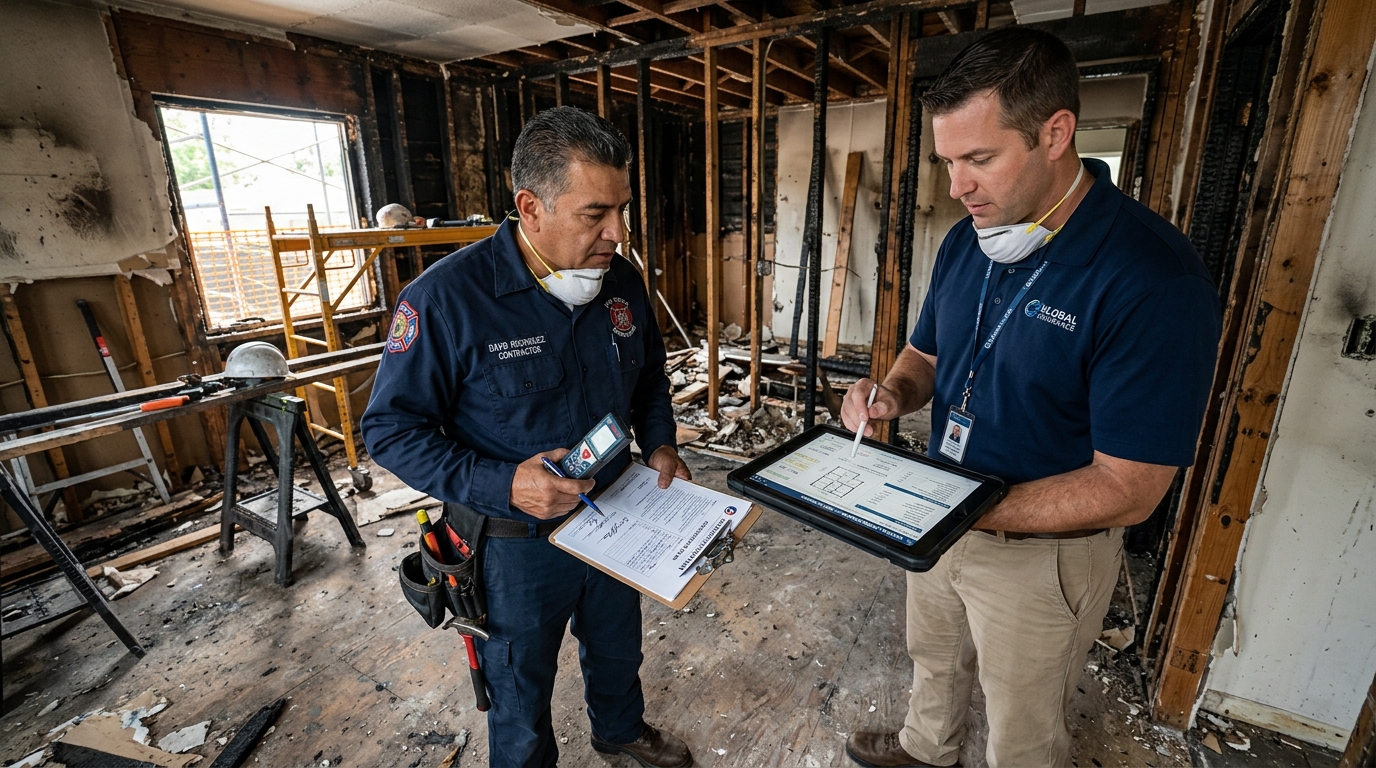
What Are the Main Stages of a Fire Damage Insurance Claim?
Understanding these phases helps policyholders anticipate carrier timelines and prevent common missteps that delay rebuilding funds.
During the initial phase, your carrier assigns a field adjuster. The adjuster inspects physical damage, measures room dimensions, and documents structural framing, electrical systems, and finishes that must be replaced.
What Is the Difference Between ACV and RCV Payouts?
Most replacement-cost policies operate on a two-check disbursement system. The carrier initially issues an ACV payment (actual cash value) to begin emergency mitigation and structural work.
The withheld funds—known as 'recoverable depreciation'—are only released to the homeowner once the contractor completes the work, submits paid invoices, and passes city building inspections.
| Coverage Feature | Actual Cash Value (ACV) | Replacement Cost Value (RCV) |
|---|---|---|
| Depreciation Deduction | Yes, subtracted based on age and wear | No, full current retail value reimbursed |
| Payout Timing | Issued immediately upon initial estimate approval | Initial ACV issued upfront; depreciation released upon completion |
| Contractor Requirement | Can be kept without repairing (subject to mortgage terms) | Requires proof of completed work and paid contractor invoices |
| Dallas Market Price Shield | Exposes owner to inflation gaps between purchase and fire date | Covers local material and labor cost increases |
How Does Xactimate Software Determine Fire Restoration Costs?
Adjusters and certified restoration contractors both use Xactimate to maintain a common pricing language. Rather than presenting arbitrary lump-sum estimates, every task—such as 'tear out wet drywall,' 'apply antimicrobial agent,' or 'replace 2x8 ceiling joist'—is assigned a standardized code and unit price.
Discrepancies between carrier estimates and contractor bids usually stem not from price-per-unit disagreements, but from omitted scope items—such as overlooked attic charring, hidden subfloor moisture, or municipal code upgrade requirements.
What Is Ordinance or Law Coverage and Why Is It Essential in Dallas?
Standard base policies only cover rebuilding a home to the exact condition it was in before the fire. If your home was built in the 1960s or 1970s in neighborhoods like Lake Highlands or East Dallas, the City of Dallas will require modern AFCI/GFCI circuit breakers, hardwired interconnected smoke alarms, and upgraded insulation.
Without Ordinance or Law coverage (Coverage B / Building Ordinance), the homeowner is responsible for paying these mandatory code-upgrade costs out of pocket.
Need Professional Assessment or Assistance?
Explore our dedicated technical division for Fire Damage Insurance Claims Assistance, find mobile response teams across all 51 Dallas coverage areas, or review our comprehensive Dallas fire damage restoration operations.
Frequently Asked Questions
Can I choose my own contractor for fire restoration?
Yes, absolutely. Texas law gives policyholders the legal right to select any licensed general contractor or restoration company they choose. You are under no obligation to use your insurance carrier's 'preferred' or recommended vendors.
What is a supplemental claim?
A supplement is an additional claim submitted to your insurance adjuster after demolition reveals hidden structural damage—such as burned framing inside wall cavities, charred roof decking under insulation, or damaged plumbing—that was not visible during the initial walkthrough.
How long do I have to file a Proof of Loss?
Most policies specify that a formal Sworn Statement in Proof of Loss must be filed within 60 days of the carrier's written request. Working with a knowledgeable restoration professional ensures all forensic inventories and Xactimate line items are accurate before submission.