Air Scrubbing After Fire in Dallas, TX
Extinguishing a fire does not clear the air. Weeks after visible smoke clears, millions of microscopic, respirable particulates (PM2.5 and PM10), acidic soot fibers, burned synthetic compounds, and volatile organic chemicals remain suspended in indoor air currents. Disturbing charred debris or wiping walls during restoration kicks these hazardous airborne particulates back into circulation. Without continuous, high-efficiency mechanical air scrubbing, occupants and restoration tradesmen inhale toxic combustion byproducts that irritate lungs and redeposit soot onto clean surfaces.
Our Dallas-based restoration teams deploy commercial HEPA air scrubbers and negative-air filtration machines across all 51 Dallas ZIP codes. Operating industrial 500 to 2,000 CFM units equipped with 99.97% certified HEPA filters and heavy extruded activated carbon/potassium permanganate vapor filters, we continuously purge indoor air, capture micro-particulates down to 0.3 microns, and establish negative-air pressure containment to protect surrounding living quarters.
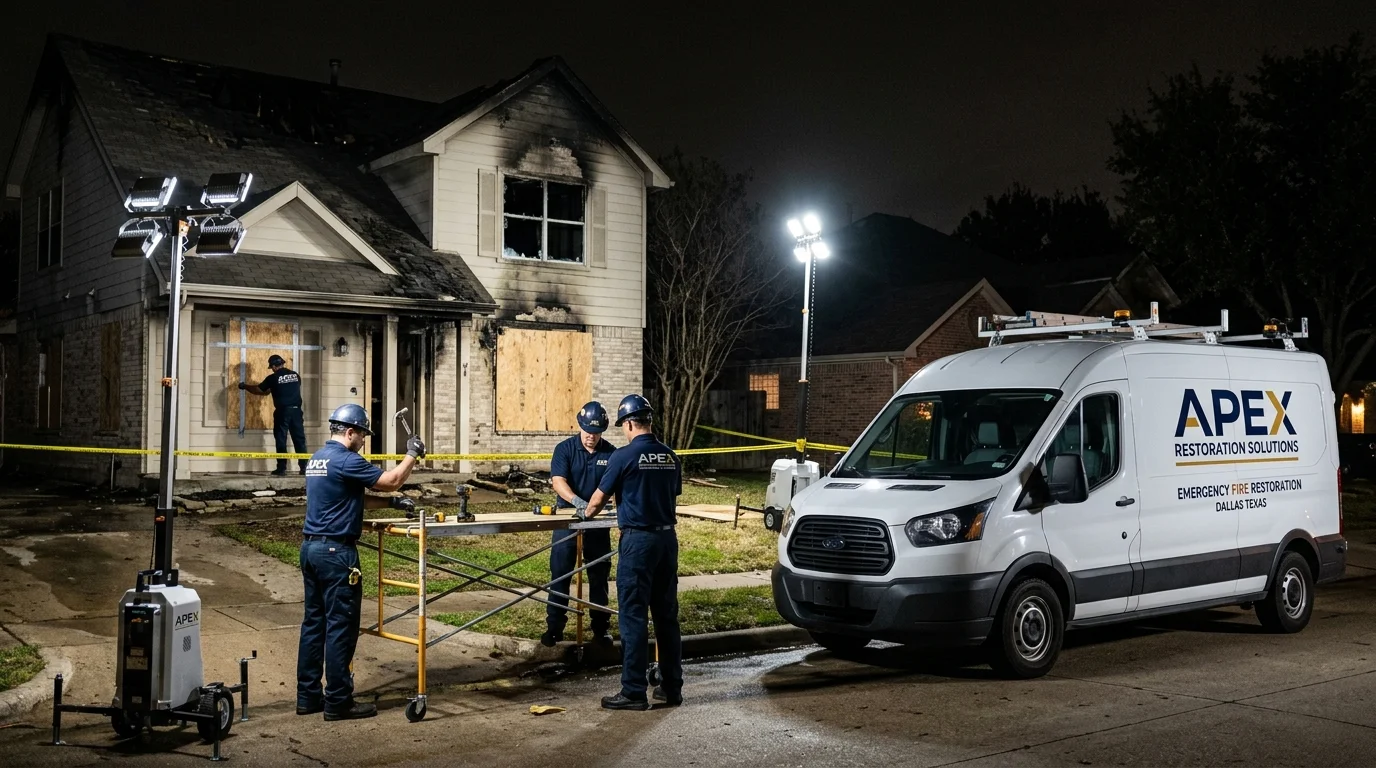
Dallas Smoke & Odor Neutralization Desk
IICRC Master Fire & Smoke specialists deployed with thermal fogging & hydroxyl systems.
How Does Industrial Air Scrubbing Work After a Fire?
Professional air scrubbers pull contaminated air through a progressive multi-stage filtration process designed to trap both solid particulates and gaseous chemical vapors:
Stage 1: Coarse Pre-Filtration (MERV 8)
Contaminated air first passes through a high-capacity polyester pre-filter that captures large airborne dust, ash particles, and construction debris, protecting secondary filters.
Stage 2: Mid-Stage Carbon / Potassium Permanganate Vapor Filter
Air flows through an industrial gas-phase adsorption bed containing virgin coconut-shell activated carbon blended with potassium permanganate to neutralize VOCs and smoke gases.
Stage 3: True HEPA Filtration (99.97% at 0.3 Microns)
Air stream passes through a certified HEPA filter composed of dense, pleated borosilicate microfibers capturing toxic soot particles and combustion aerosols.
Stage 4: Air Exchange & Recirculation
Clean, purified air is either recirculated back into the room to scrub ambient air or ducted to the exterior through flex ducting to maintain continuous negative air pressure.
Negative Air Pressure vs. Closed-Loop Air Scrubbing
Our technicians configure air scrubbers in two distinct modes depending on containment requirements:
Negative Air Pressure Mode
Filtered air is exhausted outdoors via flexible ducting through a window or exterior door.
Creates negative pressure inside the work zone, ensuring air flows inward and preventing soot from escaping into clean rooms.
Closed-Loop Scrubbing Mode
Filtered air is discharged directly back into the treated room.
Continuously circulates indoor air through filters, executing 6 to 12 complete air exchanges per hour to purify ambient air.
Frequently Asked Questions
How long do air scrubbers need to run after a fire?
Air scrubbers typically run continuously (24 hours a day) throughout the entire duration of physical debris removal, charred wood demolition, and chemical surface washing. In most residential projects, air scrubbers operate for 3 to 7 days until all surfaces are cleaned and indoor particulate counts return to baseline outdoor levels.
Does an air scrubber remove the smoke smell or just the dust?
When equipped with optional activated carbon and potassium permanganate vapor filters, our air scrubbers capture both solid soot particles and airborne gaseous smoke odor molecules (VOCs), significantly reducing smoke smells while purifying the air.
Can we live in the house while air scrubbers are running?
Yes. Commercial air scrubbers produce only a steady, low humming sound (similar to a heavy-duty air purifier or fan) and are completely safe to operate in occupied homes and functioning business offices.
What is the difference between an air scrubber and an air purifier?
While both clean air, commercial air scrubbers are heavy-duty industrial machines designed for high airflow volumes (500 to 2,000 CFM), utilize commercial-grade blower motors, and feature modular duct collars allowing them to create negative air containment—capabilities standard residential air purifiers completely lack.
Related Smoke, Soot & Odor Solutions
Overview of comprehensive molecular odor elimination.
Safe-for-occupied-spaces UV atmospheric radical decontamination.
High-output O3 gas chamber oxidation for unoccupied structures.
Micro-droplet pairing agents replicating smoke penetration.
Available Across All 51 Dallas ZIP Codes
Our emergency response and restoration specialists deploy 24/7 across every Dallas County neighborhood. Select your local district below for localized response details:
Fire Recovery & Technical Insights
What to Do in the First 24 Hours After a House Fire
Critical safety, insurance notification, and board-up steps once fire officials release the scene.
Understanding Smoke and Soot Types: Wet, Dry & Protein
Why household cleaning smears acidic soot and how chemical counteractants stop etching.
Navigating Fire Damage Insurance Claims
How Xactimate line-item estimates, ACV vs RCV, and Texas building ordinance coverage work.