Post-Fire Structural Dehumidification in Dallas, TX
Extracting standing water following firefighting operations removes bulk liquid, but thousands of pounds of moisture remain trapped deep within structural wood framing, multi-layer drywall, masonry, and concrete foundation slabs. If left to ambient evaporation, this bound moisture takes months to escape.
Accelerating deep structural drying requires advanced psychrometric dehumidification. By creating an artificially low humidity environment inside the structure, technicians establish a steep vapor pressure differential between damp building materials and surrounding air, forcing bound moisture outward into the dry air stream.
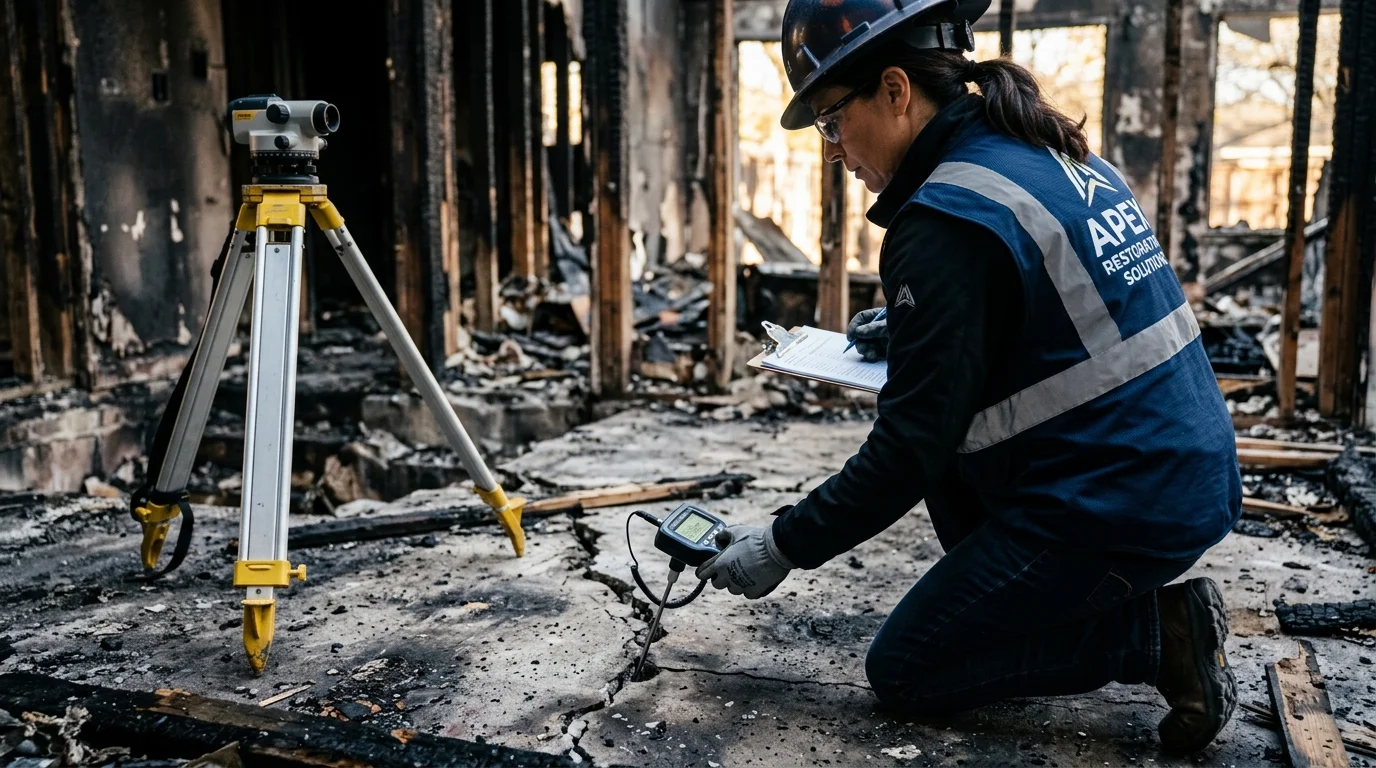
Dallas Firefighting Water Extraction & Drying Desk
IICRC certified water extraction specialists & structural psychrometric drying crews deployed across Dallas County.
Comparing Dehumidification Technologies: LGR vs. Desiccant
Choosing the correct dehumidification system is critical to drying efficiency:
Low-Grain Refrigerant (LGR) Dehumidifiers
Pre-cools incoming air before evaporator coils, continuing to extract moisture down to 34 GPP and 30% RH. Ideal for standard residential and commercial framing in warm conditions.
Industrial Desiccant Wheel Dehumidifiers
Rotating silica gel rotor chemically adsorbs moisture, operating down to single-digit GPP and sub-10% RH. Ideal for cold environments, dense concrete slabs, and hardwood preservation.
Psychrometric Principles of Post-Fire Drying
Our technicians apply rigorous scientific principles to accelerate the structural drying process:
Grains Per Pound (GPP) Reduction
Commercial LGR units reduce specific humidity below 35 GPP, while desiccant units drop GPP below 15, aggressively drawing moisture out of deep framing timbers.
Vapor Pressure Differential Optimization
Maintaining low room vapor pressure (~0.2 to 0.3 in. Hg) creates a continuous gradient that pulls saturated moisture (~1.0 in. Hg) outward to the surface of timbers.
High-Velocity Boundary Layer Airflow
Axial air movers positioned every 10 to 14 linear feet break the stagnant boundary layer of high humidity against walls, accelerating moisture evaporation.
Closed Drying Chamber Protocols
Sealing all windows, doors, and exterior dampers ensures dehumidifiers process only interior air rather than battling humid North Texas outdoor weather.
Frequently Asked Questions
Can I just open windows and run ceiling fans to dry the house?
In North Texas, opening windows almost always impedes drying. Dallas's outdoor relative humidity frequently exceeds 70% to 90%, especially in spring and summer. Bringing humid outdoor air inside introduces more moisture into wet framing, slowing evaporation and drastically accelerating mold growth. Structural drying requires a closed, mechanically dehumidified chamber.
How much water can an industrial LGR dehumidifier remove per day?
Our commercial LGR dehumidifiers extract between 110 and 250 pints (14 to 31 gallons) of water per day per unit under AHAM testing conditions (80°F and 60% RH). In heavily saturated fire suppression environments, a multi-unit deployment routinely extracts hundreds of gallons of water from building framing daily.
What causes hardwood or subfloors to buckle if dehumidification is delayed?
Wood is hygroscopic; it absorbs water and expands across the grain. When water remains in the subfloor or underside of floorboards, the bottom of the wood expands faster than the top, causing severe cupping and crowning. Rapid dehumidification balances moisture content through the wood thickness, flattening boards before permanent cellular compression occurs.
Related Suppression Water & Drying Solutions
Central overview of fire suppression water extraction and drying.
Infrared thermal imaging moisture mapping and dry standards.
Attack line suppression water extraction and cavity drying.
Commercial and residential sprinkler deluge water remediation.
Available Across All 51 Dallas ZIP Codes
Our emergency response and restoration specialists deploy 24/7 across every Dallas County neighborhood. Select your local district below for localized response details:
Fire Recovery & Technical Insights
What to Do in the First 24 Hours After a House Fire
Critical safety, insurance notification, and board-up steps once fire officials release the scene.
Understanding Smoke and Soot Types: Wet, Dry & Protein
Why household cleaning smears acidic soot and how chemical counteractants stop etching.
Navigating Fire Damage Insurance Claims
How Xactimate line-item estimates, ACV vs RCV, and Texas building ordinance coverage work.