The Hidden Threat: Managing Firefighting Water Damage and Preventing Post-Fire Mold
Thousands of gallons of water used to suppress a residential fire saturate subfloors and wall cavities. Here is how professional structural drying stops mold before it starts.
Key Answer & Essential Rule
Fire suppression efforts deploy thousands of gallons of water into a burning building. In the warm North Texas climate, microbial amplification (mold growth) begins on wet drywall and timber within 24 to 48 hours unless commercial extraction and LGR dehumidification are deployed immediately.
How Much Water Is Used in Fire Suppression and Where Does It Go?
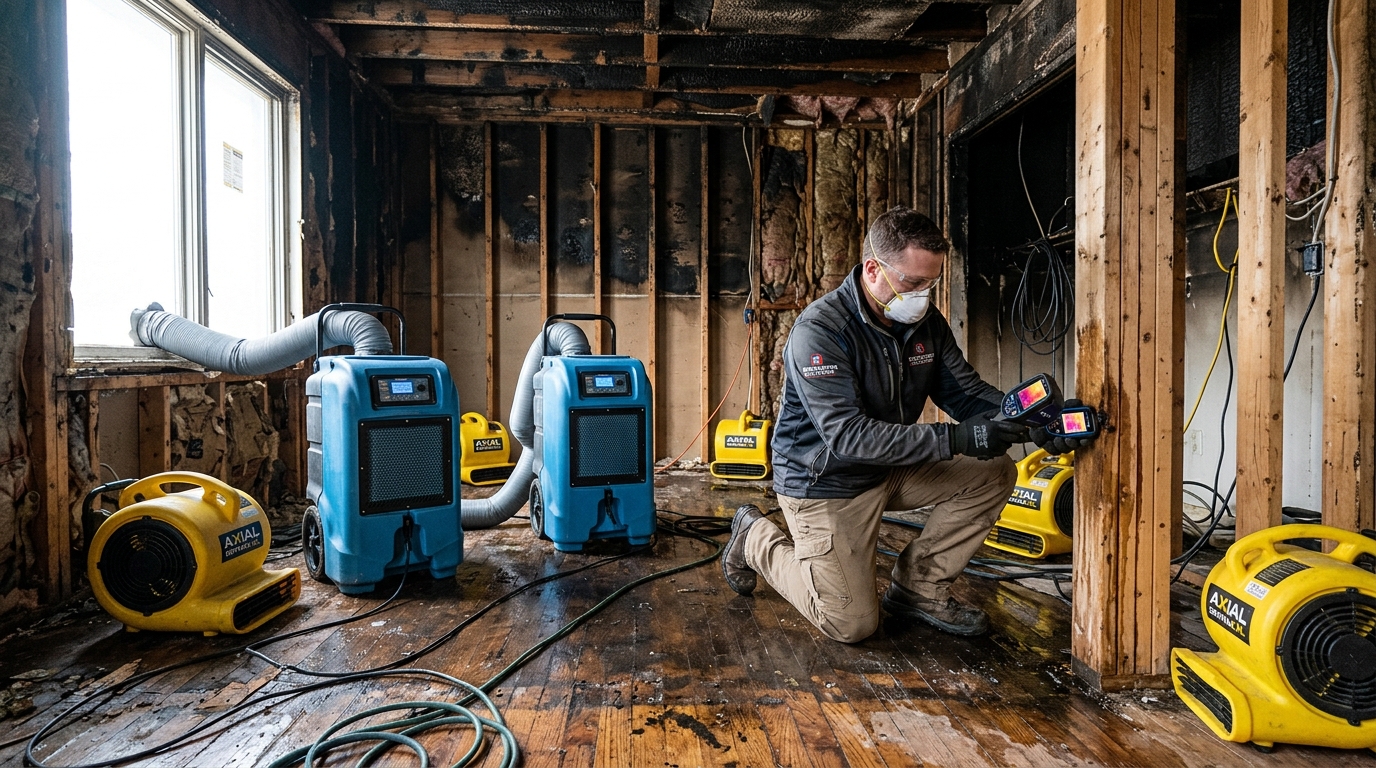
While flames may have been isolated to an attic or upper-story bedroom, gravity pulls suppression water through exterior and interior wall cavities into the ground floor and crawlspaces.
Trapped water inside insulated exterior walls creates an invisible reservoir. Wet fiberglass and cellulose insulation lose their R-value completely and retain moisture against wood studs, creating optimal micro-climates for rapid fungal colonization.
Why Is the 24-to-48 Hour Window Critical for Mold Prevention?
In North Texas, warm ambient temperatures and high humidity accelerate mold germination. Secondary mold damage resulting from delayed drying is frequently disputed by insurance adjusters if the property owner failed to initiate timely water extraction and structural drying.
Prompt extraction of standing water and application of EPA-registered antimicrobial botanical disinfectants halts fungal germination while structural drying equipment is configured.
Why Standard Household Fans Cannot Dry Firefighting Water?
Psychrometric science measures temperature, relative humidity, specific humidity (grains per pound, or GPP), and dew point. Industrial LGR dehumidifiers remove moisture from air at much lower relative humidity levels than consumer units, creating high vapor pressure differentials that draw deep moisture out of structural framing.
Using standard fans in a fire-damaged environment without HEPA containment is hazardous because high-speed uncontrolled airflow aerosolizes toxic soot and ash particles, distributing respiratory irritants into previously clean areas.
| Drying Method | Equipment Utilized | Drying Depth | Air Quality Protection |
|---|---|---|---|
| DIY Household Fans | Standard box/pedestal fans | Surface evaporation only (< 0.25 inch) | Spreads airborne soot, ash, and mold spores throughout rooms |
| Commercial Extraction | Submersible pumps, ride-on extractors | Bulk water removal (up to 95% standing water) | Direct containment pumping to sanitary disposal |
| Psychrometric LGR Drying | Commercial LGR units, axial air movers | Deep structural drying through subfloors and framing | Operates in tandem with commercial HEPA air filtration |
How Do Restorers Verify Structural Dryness?
Infrared thermal imaging identifies hidden evaporative cooling signatures inside ceiling cavities and behind baseboards without requiring destructive drywall cutting.
Daily psychrometric logs document temperature, relative humidity, and GPP readings at both dehumidifier exhausts and ambient room environments, providing the exact engineering documentation insurance carriers require to approve structural drying invoices.
Need Professional Assessment or Assistance?
Explore our dedicated technical division for Firefighting Water Damage Extraction, find mobile response teams across all 51 Dallas coverage areas, or review our comprehensive Dallas fire damage restoration operations.
Frequently Asked Questions
Does insurance cover mold resulting from firefighting water?
Yes, in most cases. When mold is a direct secondary consequence of water used by municipal firefighters to extinguish a covered fire loss, it is typically covered under the fire peril claim rather than the standard, restrictive mold endorsement cap.
How long does it take to dry a house after firefighting water damage?
Under professional IICRC S500 protocols using industrial LGR dehumidification and air movers, complete structural drying typically takes between 3 to 5 days, depending on timber density, insulation saturation, and ambient humidity.
Should drywall be removed if it got wet during the fire?
If drywall has absorbed contaminated fire water (Category 3), suffered structural sagging, or remained wet for more than 48 hours, controlled selective demolition (flood cutting 12 to 24 inches above the moisture line) is required by industry standards to allow framing inspection and drying.